


For many years, the story of American manufacturing has been one of decline – job losses, plant closures, and a steady shift in production abroad. However, that story is being rewritten. Before the pandemic there was a clear sense that the economics that drove manufacturing abroad were becoming less compelling as labour content was reducing with automation, and labour price differentials were narrowing. The pandemic highlighted the national security risks of extended supply chains dependent on the prioritization of foreign countries. Now, with increased automation, more advanced artificial intelligence, and nextgeneration production techniques like 3D printing a quiet renaissance is being enabled.
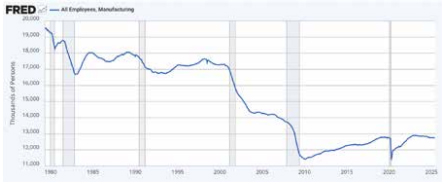
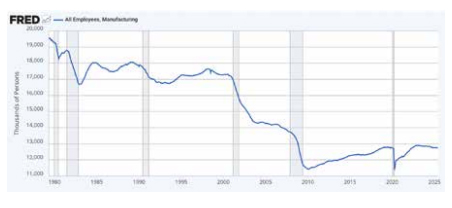 U.S. Bureau of Labour Statistics, All Employees, Manufacturing [MANEMP], retrieved from FRED, Federal Reserve Bank of St. Louis.
This is not about nostalgia or going back in time. Making something more intelligent, cleaner, faster, and competitive is the goal. Despite declining employment, U.S. manufacturing output has increased by more than 70 percent since 1990 – clear proof of the country's soaring productivity. What it means to make things in America is changing due to a new generation of tools, processes, and builders.
U.S. Bureau of Labour Statistics, Manufacturing Sector: Real Sectoral Output for All Workers [OUTMS], retrieved from FRED, Federal Reserve Bank of St. Louis.
The factories at the forefront of this change don't resemble those of the past. The expansive, labour-intensive facilities are no longer core. Lean, high-tech operations built for speed, accuracy, and flexibility can replace them. Companies can now design, print, and deliver products in days rather than months with less waste, thanks to 3D printing's elimination of molds and minimum orders. These days, entire categories, from toys to industrial parts, can be created based on demand. Mass production is different now and mass customization, with much lower overhead and closer to the customer is increasingly possible.
 The factory floor is changing due to automation and robotics. Humans can take on higher-value jobs in programming, diagnostics, and systems management, while machines increasingly handle hazardous, repetitive tasks. Real-time production adjustments, supply chain management, and equipment failure prediction are all made possible by artificial intelligence. Electrification, or the transition from high-heat, fossil fuel-powered systems to modular, clean, electric infrastructure, is the foundation of it all. These aren't just improvements. They are a complete overhaul of American manufacturing.
“Smart, automated, tech-enabled production that generates genuine value domestically is replacing the antiquated model of low-cost labour and long-distance logistics”
Batteries aren’t just powering devices; they are powering the next industrial revolution. Not the ones in your phone, but the ones that back whole energy grids, data centers, and electric vehicles. The majority are still produced today using antiquated, carbon-intensive processes that depend on heat, solvents, and international supply chains. That is about to change, in part thanks to Robert Bagheri, an electrical engineer and the founder of eight startups, including three initial public offerings. His most recent business created a dry-printing platform that uses an additive, quick, and clean method to create battery electrodes. It allows for local, low-emission production without retooling entire factories because it works with a variety of materials and product types. Consider it a faster, cleaner, and far more adaptable version of the assembly line for the twenty-first century. Better batteries are not the only objective; a more intelligent and scalable method of production is also desired.
The overall economic picture is equally strong. About ten percent of U.S. GDP, or $2.94 trillion, came from manufacturing in 2024. But, its impact is even greater: the U.S. economy benefits by $2.64 for every dollar invested in US manufacturing. Among all sectors, it has one of the highest multipliers. A single factory supports entire ecosystems, including suppliers, logistics, construction, energy, and local services, in addition to producing goods. Impact meets industry here.
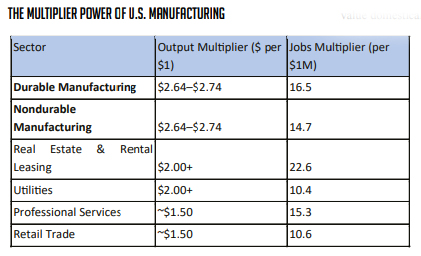 Economic Policy Institute (EPI) analysis of data from the Bureau of Labour Statistics Employment Requirements Matrices, the BLS Current Employment Statistics program, and the Bureau of Economic Analysis GDP-byindustry accounts.
Additionally, there has never been a more compelling argument for domestic production. Businesses historically offshored their operations for years to find cheaper labour. However, because of automation, sophisticated software, and more efficient workflows, labour now accounts for just 10–15 percent of manufacturing costs in many U.S. industries. When you factor in supply chain risks, inventory delays, and growing shipping costs, local manufacturing becomes not just feasible but strategic.
What is emerging is a new industrial foundation built on speed, flexibility, and intelligence rather than a return to the past. Smart, automated, tech-enabled production that generates genuine value domestically is replacing the antiquated model of low-cost labour and long-distance logistics.
This isn't a passing trend or a response to transient shocks. New tools, new talent, and new priorities are driving this structural change and reinvention. We are changing the definition of manufacturing in the twenty-first century by printing every part, optimizing every machine, and building every product closer to the point of need. And that means the chance to create something lasting, not just something temporary, for operators, investors, and founders alike. The future of manufacturing isn’t offshore. It’s already under construction – right here in America.
